Rocket Failures
Antares Orb-3
The resupply mission erased by a turbopump failure moments after liftoff.
The knowledge that remained
Knowledge that outlived the failure.
- 01
A single propulsion component can determine the fate of an entire mission.
- 02
Launch systems concentrate enormous operational value into a few critical seconds.
- 03
Failure records should preserve both the technical cause and the cargo that was lost.
Orbital publicly identified the liquid-oxygen and kerosene turbopump in one engine as the direct cause recorded in the NASA oversight report.
Timeline
The sequence of failure.
- 01Conditions2014
Orb-3 launches
Antares lifts off carrying Cygnus and 2,293 kilograms of ISS cargo.
- 02FailureMOMENTS LATER
An engine fails
A first-stage propulsion failure removes the thrust needed to climb.
- 03FailureSECONDS LATER
The vehicle falls
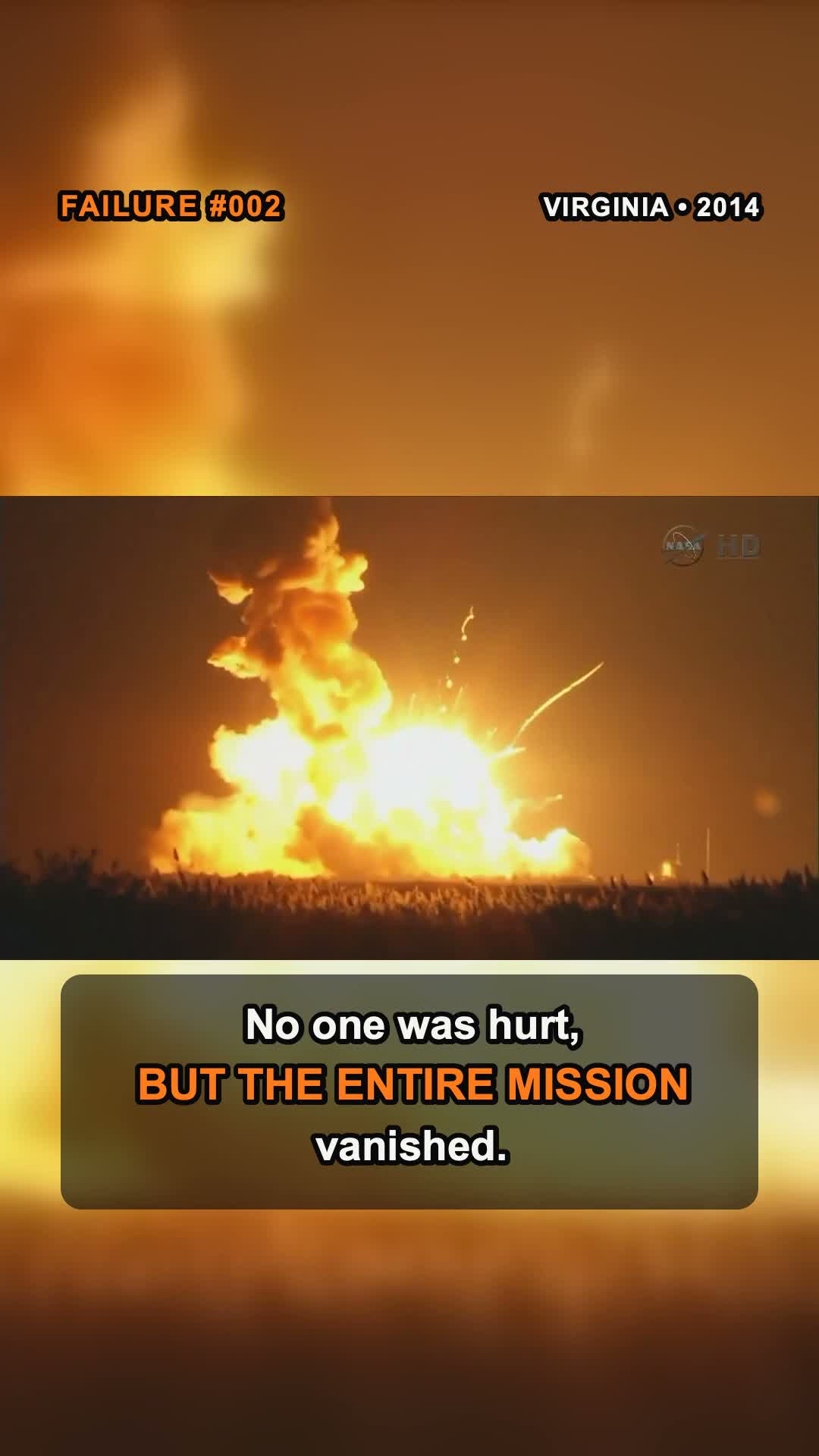
The rocket descends near the pad and explodes.
- 04InvestigationAFTERMATH
The mission is lost
Rocket, spacecraft, and all cargo are destroyed without human injury.
The event.
On the Orb-3 mission, Antares lifted off with a Cygnus spacecraft and 2,293 kilograms of cargo bound for the International Space Station.
The loss erased a complete resupply mission in seconds and damaged the launch site, showing how a single propulsion component can end an otherwise prepared flight.
The mechanism.
A first-stage engine turbopump failure caused a catastrophic loss of thrust.
Moments later, the vehicle suffered a propulsion failure, fell back near the launch pad, and exploded. No one was hurt, but the rocket, spacecraft, and cargo were destroyed.
Sources & references
Trace the evidence.
Media rights record: NASA TV footage and NASA imagery are public domain in the United States.
Discovery edition
The case in under one minute.
The Short introduces the event. This archive record preserves the mechanism, evidence, and engineering lesson beyond the video.
Editorial derivatives
Editions from this case.
A portable, source-backed edition of the complete case.
The failure sequence formatted for print and classroom display.
Mechanism, consequence, and lesson in one visual system.
Discussion prompts, activities, and a structured answer guide.
The question to remember
Can one component still destroy an entire mission?
Yes. Launch systems concentrate enormous value into a small number of components operating near their limits.