Space Mission Failures
Challenger
The launch that showed an organizational decision can be as dangerous as a failed component.

The knowledge that remained
Knowledge that outlived the failure.
- 01
Technical warnings are useless if the organization cannot act on them.
- 02
Launch decisions must preserve uncertainty instead of averaging it away.
- 03
Safety culture is part of the engineered system, not an administrative layer around it.
The Rogers Commission found failures in engineering and in organizational decision-making, making Challenger an enduring case study in safety culture.
Timeline
The sequence of failure.
- 01ConditionsJAN 28, 1986
Cold launch conditions
Challenger is prepared for flight in unusually low temperatures.
- 02WarningBEFORE LAUNCH
Engineers warn
Concerns are raised about critical O-ring performance in the cold.
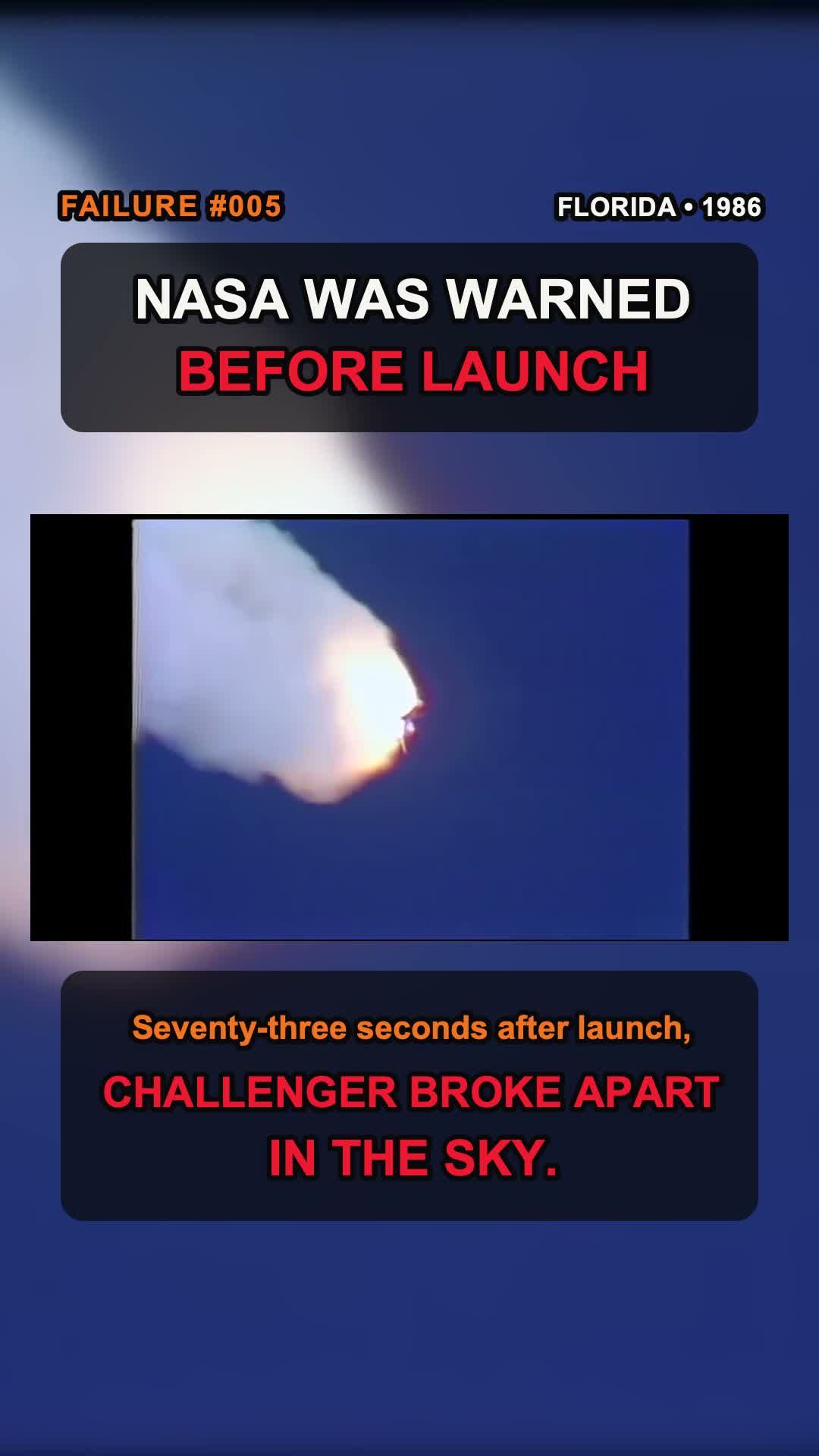
- 03FailureT+73 SECONDS
The vehicle breaks apart
A seal failure allows hot gas to escape and the external tank fails.
- 04InvestigationAFTERMATH
The decision is investigated
The Rogers Commission finds both technical and organizational failures.
The event.
Space Shuttle Challenger launched on January 28, 1986, after engineers had raised concerns about the effect of cold weather on the solid rocket booster joint seals.
The accident killed all seven crew members and halted the shuttle program while investigators reconstructed both the technical failure and the decision to launch.
The mechanism.
A booster joint seal failed after warnings about O-ring performance in cold conditions.
A seal failed, hot gas escaped, and the external fuel tank broke apart. All seven crew members died.
Sources & references
Trace the evidence.
Media rights record: NASA launch and breakup footage used by the episode is public domain.
Discovery edition
The case in under one minute.
The Short introduces the event. This archive record preserves the mechanism, evidence, and engineering lesson beyond the video.
Short ready for releaseEditorial derivatives
Editions from this case.
A portable, source-backed edition of the complete case.
The failure sequence formatted for print and classroom display.
Mechanism, consequence, and lesson in one visual system.
Discussion prompts, activities, and a structured answer guide.
The question to remember
Was Challenger only an engineering failure?
No. The investigation connected the failed seal to the organizational process that allowed the launch to proceed despite warnings.