Space Mission Failures
NOAA N-Prime
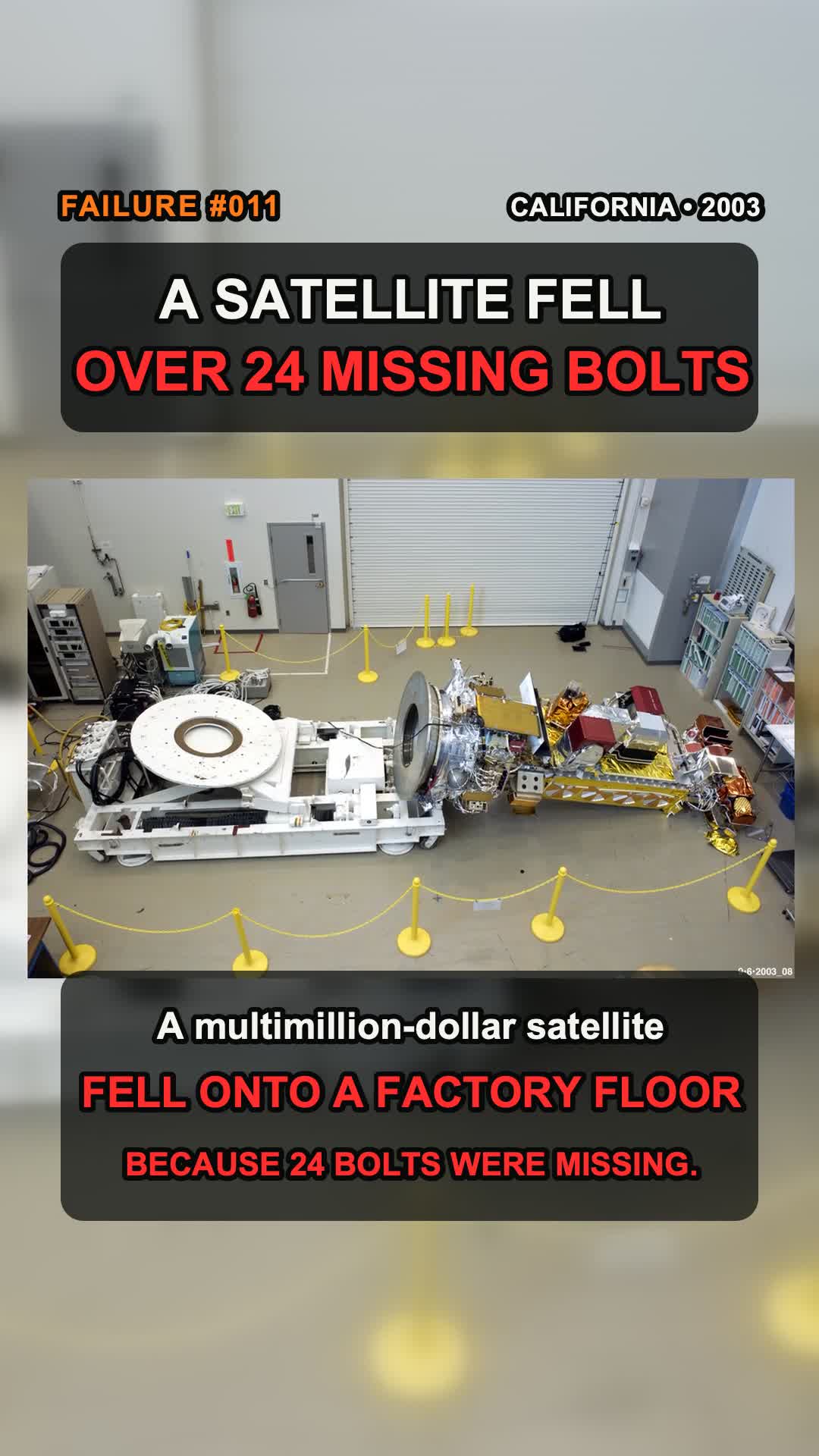
The multimillion-dollar satellite dropped inside a controlled facility because nobody verified twenty-four bolts.
The knowledge that remained
Knowledge that outlived the failure.
- 01
A checklist must verify physical state, not merely document intended procedure.
- 02
Responsibility becomes dangerous when every participant assumes someone else checked.
- 03
Controlled facilities still need defenses against simple handling errors.
The spacecraft was eventually repaired and launched as NOAA-19. The mishap remains a stark example of why physical checks and clear responsibility matter.
Timeline
The sequence of failure.
- 01Conditions2003
Bolts are removed
Twenty-four bolts securing the adapter plate are no longer installed.
- 02DecisionHANDLING
The team begins rotation
Technicians move the spacecraft without verifying the plate’s physical state.
- 03FailureSECONDS LATER
The satellite falls
NOAA N-Prime slips from its cart and drops approximately three feet.
- 04InvestigationAFTERMATH
The spacecraft is repaired
After heavy damage and recovery work, it eventually launches as NOAA-19.
The event.
In 2003, technicians prepared to rotate NOAA N-Prime from vertical to horizontal. Its adapter plate was supposed to be secured to the handling cart with twenty-four bolts.
The satellite required extensive repair after a preventable handling accident inside a controlled facility.
The mechanism.
The satellite was rotated without verifying that twenty-four securing bolts were installed.
The bolts had been removed, and the team failed to verify their status. The satellite slipped from the cart and crashed onto the factory floor.
Sources & references
Trace the evidence.
Media rights record: Accident, clean-room, and launch imagery used by the episode are public-domain NASA media.
Discovery edition
The case in under one minute.
The Short introduces the event. This archive record preserves the mechanism, evidence, and engineering lesson beyond the video.
Short ready for releaseEditorial derivatives
Editions from this case.
A portable, source-backed edition of the complete case.
The failure sequence formatted for print and classroom display.
Mechanism, consequence, and lesson in one visual system.
Discussion prompts, activities, and a structured answer guide.
The question to remember
Could a physical checklist have prevented this accident?
Yes—if it required direct verification of the bolts rather than assuming another person or previous step had secured them.