Aircraft Failures
Boeing 720
The aviation-safety experiment that failed its main objective and still produced valuable evidence.
The knowledge that remained
Knowledge that outlived the failure.
- 01
A failed experiment can still produce valuable safety data.
- 02
Test geometry can interact with a technology in ways that defeat its intended benefit.
- 03
Success criteria must separate the primary objective from secondary learning.
The antimisting kerosene failed its primary objective, while the crash still produced useful data about aircraft structures and passenger survivability.
Timeline
The sequence of failure.
- 01ConditionsDEC 01, 1984
The remote approach
A Boeing 720 is flown toward a prepared impact site without people aboard.
- 02FailureIMPACT
Wing openers strike
Steel structures cut into the aircraft during the controlled crash.
- 03FailureSECONDS LATER
Fuel ignites
A cutter damages an engine and a large fuel-fed fire surrounds the aircraft.
- 04InvestigationAFTERMATH
Mixed results
The fuel experiment fails, but crashworthiness data remains useful.
The event.
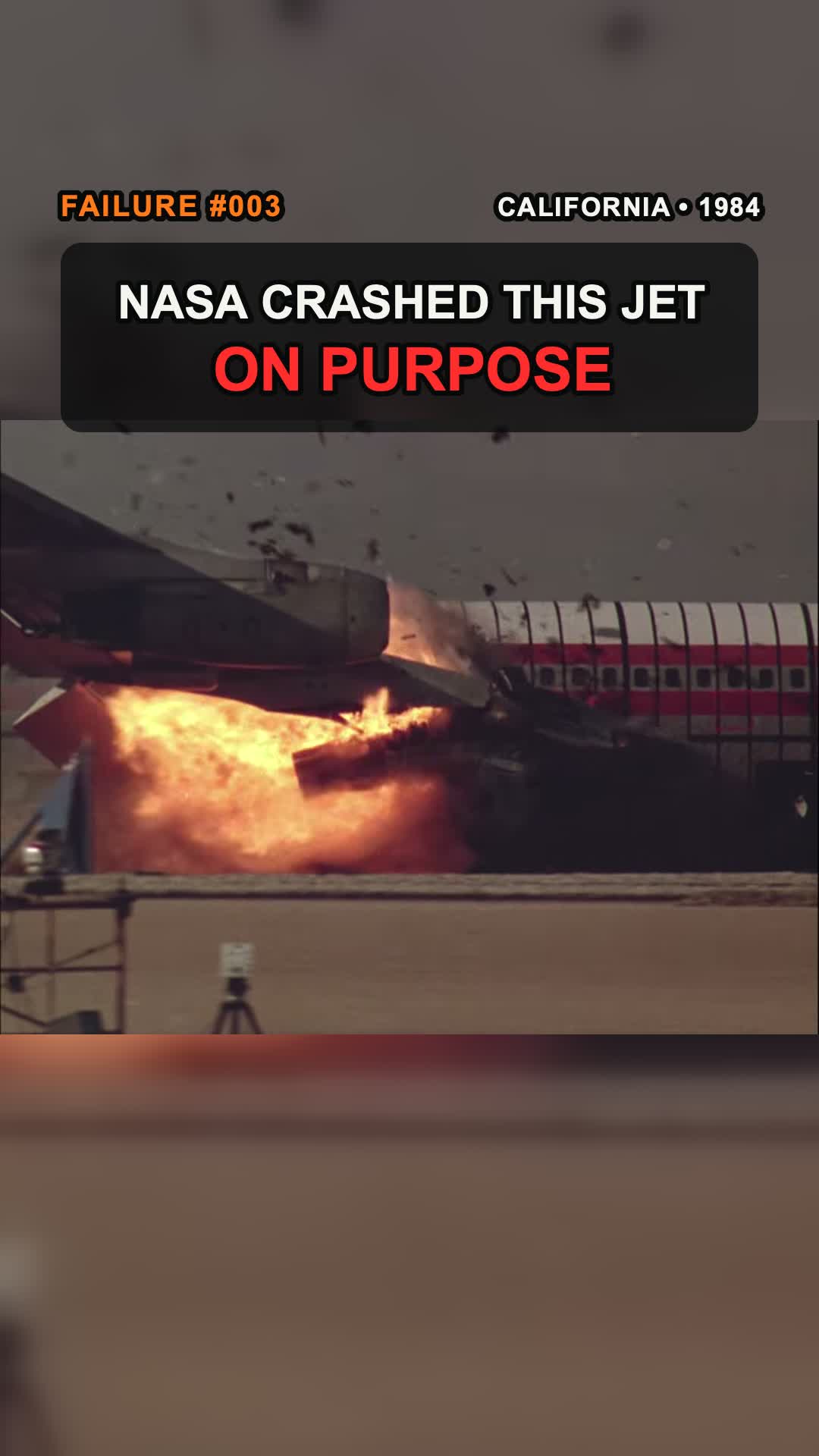
The Controlled Impact Demonstration was designed to collect crash-survival data and test technologies intended to make aircraft accidents safer.
No people were aboard, but the central fuel experiment suffered a major setback. The fire took more than an hour to extinguish.
The mechanism.
Impact damage released fuel faster than the experimental formulation could suppress fire.
Engineers filled a Boeing 720 with antimisting kerosene and flew it by remote control into steel structures. A cutter struck an engine, created a massive fuel leak, and the aircraft was enveloped in fire.
Sources & references
Trace the evidence.
Media rights record: NASA footage is public domain in the United States.
Discovery edition
The case in under one minute.
The Short introduces the event. This archive record preserves the mechanism, evidence, and engineering lesson beyond the video.
Editorial derivatives
Editions from this case.
A portable, source-backed edition of the complete case.
The failure sequence formatted for print and classroom display.
Mechanism, consequence, and lesson in one visual system.
Discussion prompts, activities, and a structured answer guide.
The question to remember
Was the controlled crash a total failure?
No. The antimisting fuel did not work well enough, but the test still produced evidence about structures, fire, and survivability.