Maritime Disasters
Herald of Free Enterprise
A roll-on/roll-off ferry sailed with its bow doors open after unsafe assumptions and missing defenses became normal operations.
The knowledge that remained
Knowledge that outlived the failure.
- 01
Critical closures need direct indication or an interlock where the operating decision is made.
- 02
An individual mistake becomes catastrophic when the organization has normalized missing checks and ambiguous responsibility.
- 03
Open vehicle decks make roll-on/roll-off ferries especially vulnerable to rapid free-surface instability.
The formal investigation’s language about a corporate culture of negligence became a lasting safety lesson and helped drive changes in ferry design, door indication, stability, and operating practice.
Timeline
The sequence of failure.
- 01ConditionsMAR 06, 1987
The ferry prepares to sail
Herald of Free Enterprise loads passengers, vehicles, and freight at Zeebrugge.
- 02WarningDEPARTURE
The bow doors remain open
The crew member assigned to close them is asleep and the bridge has no direct indicator of their state.
- 03DecisionOUTER MOLE
Water floods the vehicle deck
As the ferry accelerates, seawater pours through the open bow and spreads across the wide deck.
- 04DecisionMINUTES LATER
The ship capsizes
The sudden free-surface effect destroys stability before the vessel clears the harbor approach.
The event.
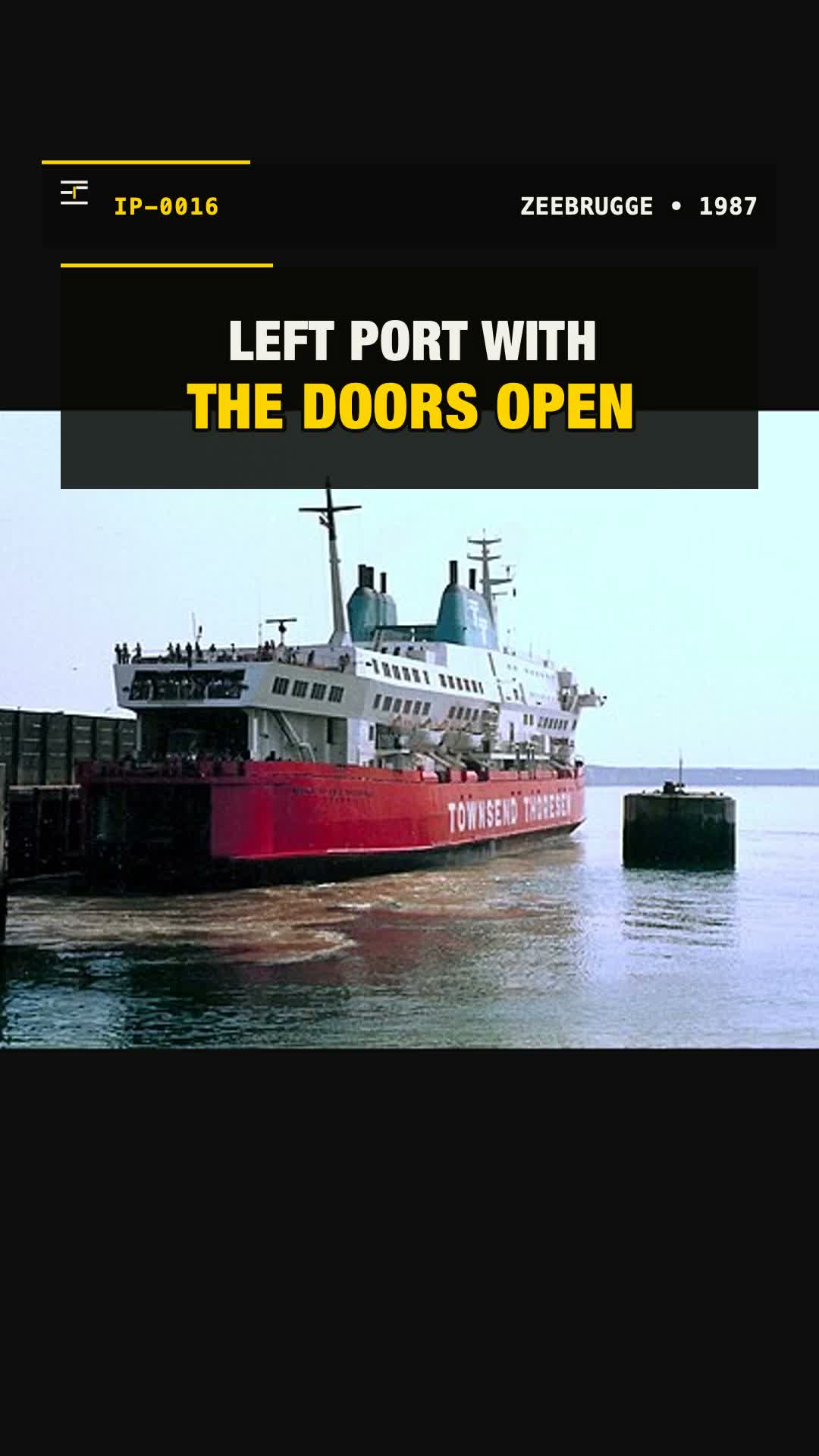
Herald of Free Enterprise was a roll-on/roll-off ferry carrying hundreds of passengers across the English Channel. On March 6, 1987, it departed Zeebrugge with its inner and outer bow doors open.
The capsizing killed 188 people. The vessel came to rest on its side in shallow water, allowing many others to be rescued.
The mechanism.
The ferry accelerated with its bow doors open, allowing water onto the undivided vehicle deck and causing a rapid loss of stability.
As the vessel accelerated, water entered the open vehicle deck. The broad, undivided surface allowed water to move laterally and destroy the ship’s stability with extraordinary speed.
Sources & references
Trace the evidence.
Media rights record: The vessel reference photograph by Franz Golhen is public domain and is not presented as accident footage. Original flooding diagrams are Instinto Archive editorial work.
Discovery edition
The case in under one minute.
The Short introduces the event. This archive record preserves the mechanism, evidence, and engineering lesson beyond the video.
Short ready for releaseEditorial derivatives
Editions from this case.
A portable, source-backed edition of the complete case.
The failure sequence formatted for print and classroom display.
Mechanism, consequence, and lesson in one visual system.
Discussion prompts, activities, and a structured answer guide.
The question to remember
Was the disaster caused by one sleeping crew member?
His absence left the doors open, but the formal investigation found a much wider failure: no bridge indication, unclear responsibility, unsafe operating practices, and serious organizational negligence.