Rail Disasters
Lac-Mégantic
An unattended crude-oil train lost braking force on a descending grade and accelerated into the center of a sleeping town.
The knowledge that remained
Knowledge that outlived the failure.
- 01
Brake-effectiveness tests must isolate the protection being tested.
- 02
Hazardous-material transport needs defenses that assume equipment, procedures, and oversight can fail together.
- 03
Safety culture and regulatory surveillance are causal parts of the transportation system.
The investigation drove new securement, tank-car, train-operation, and hazardous-material rules while preserving a broader lesson about weak safety culture and fragmented oversight.
Timeline
The sequence of failure.
- 01ConditionsJUL 05, 2013
The train is left at Nantes
Five locomotives and 72 tank cars carrying crude oil are parked on a descending grade.
- 02DecisionOVERNIGHT
Braking protection declines
After the lead locomotive is shut down, air pressure gradually drops while too few hand brakes hold the train.
- 03DecisionRUNAWAY
The train reaches 65 mph
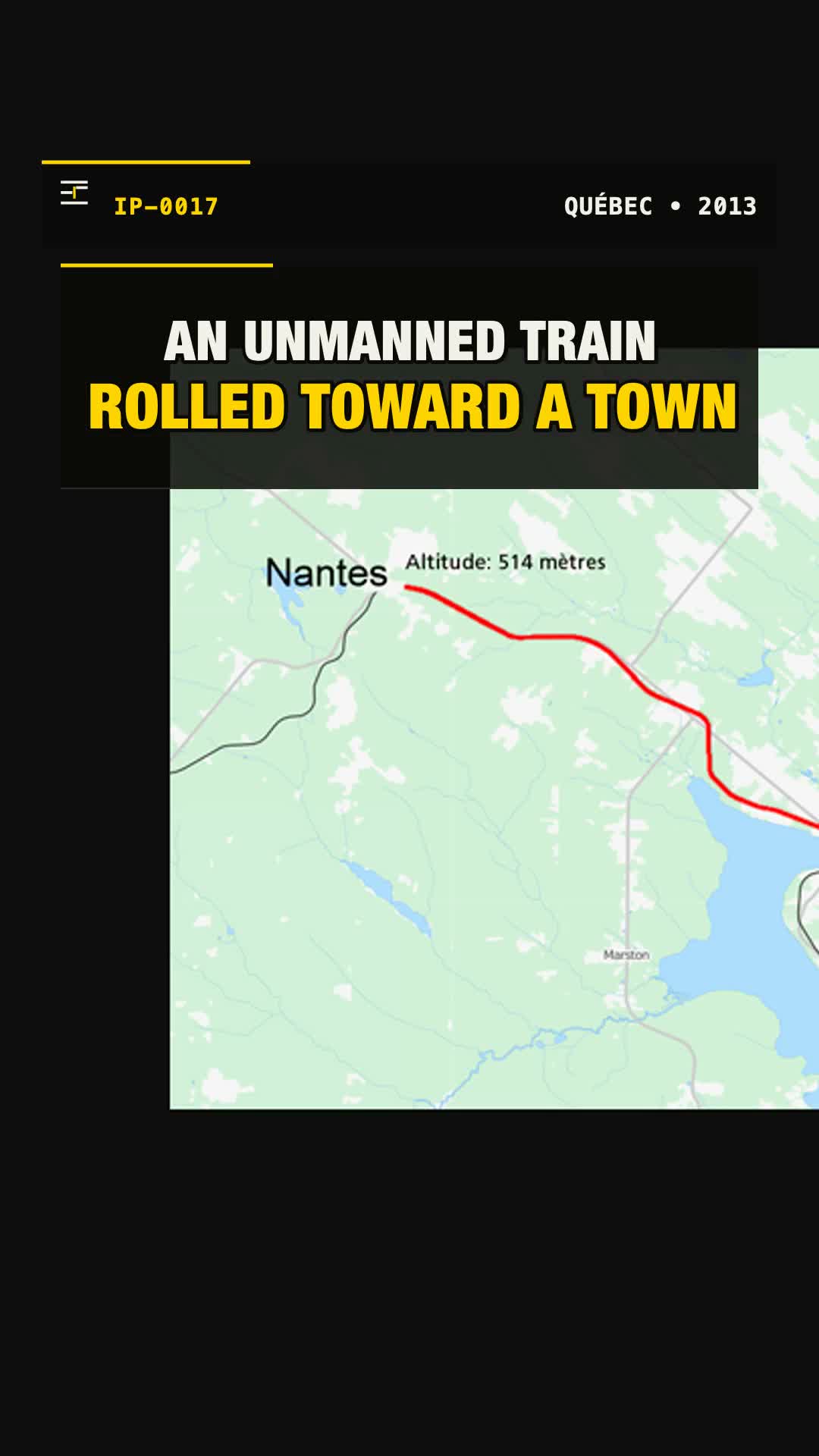
The unmanned train rolls approximately seven miles downhill toward Lac-Mégantic.
- 04Decision01:14
Tank cars derail and burn
Sixty-three cars derail near the town center and millions of liters of crude oil are released.
The event.
The Montreal, Maine & Atlantic Railway train consisted of five locomotives and 72 Class 111 tank cars loaded with crude oil. It was left unattended on a descending grade near Nantes, Québec.
The disaster killed 47 people, destroyed much of the downtown area, displaced roughly 2,000 residents, and released about six million liters of oil.
The mechanism.
An inadequate number of effective hand brakes and a flawed effectiveness test allowed the unattended train to roll after air-brake pressure declined.
The hand-brake effectiveness test was performed while air brakes were still applied, masking the weakness of the manual securement. When air pressure declined, the train began to move.
Sources & references
Trace the evidence.
Media rights record: The fire image is CC BY-SA 1.0 and the aerial image is CC BY 4.0; attribution is retained in the production rights register. The trajectory illustration is CC0.
Discovery edition
The case in under one minute.
The Short introduces the event. This archive record preserves the mechanism, evidence, and engineering lesson beyond the video.
Short ready for releaseEditorial derivatives
Editions from this case.
A portable, source-backed edition of the complete case.
The failure sequence formatted for print and classroom display.
Mechanism, consequence, and lesson in one visual system.
Discussion prompts, activities, and a structured answer guide.
The question to remember
Did one failed brake cause Lac-Mégantic?
No. Canada’s Transportation Safety Board identified eighteen causes and contributing factors spanning brake testing, securement, equipment, operating practice, safety culture, and regulatory oversight.