Aircraft Failures
Air France 447
A temporary loss of reliable airspeed data became a sustained high-altitude stall that the crew never identified.
The knowledge that remained
Knowledge that outlived the failure.
- 01
A temporary sensor problem can become catastrophic when the crew cannot reconstruct the aircraft’s state.
- 02
Training must prepare pilots for high-altitude manual control and unreliable airspeed.
- 03
Cockpit coordination must make conflicting control inputs and flight-path evidence visible to the whole crew.
The investigation changed training, procedures, sensor standards, and the aviation industry’s understanding of manual flight at high altitude after automation disconnects.
Timeline
The sequence of failure.
- 01ConditionsJUN 01, 2009
AF447 crosses the Atlantic
The Airbus A330 flies overnight from Rio de Janeiro toward Paris with 228 people aboard.
- 02Decision02:10 UTC
Airspeed becomes inconsistent
Ice crystals likely obstruct the Pitot probes and the autopilot and autothrust disconnect.
- 03DecisionSECONDS LATER
The aircraft enters a stall
Nose-up inputs raise the angle of attack and the aircraft begins a sustained descent.
- 04Investigation3 MIN 30 SEC
The stall continues to impact
The crew never identifies the stall or applies an effective recovery response.
The event.
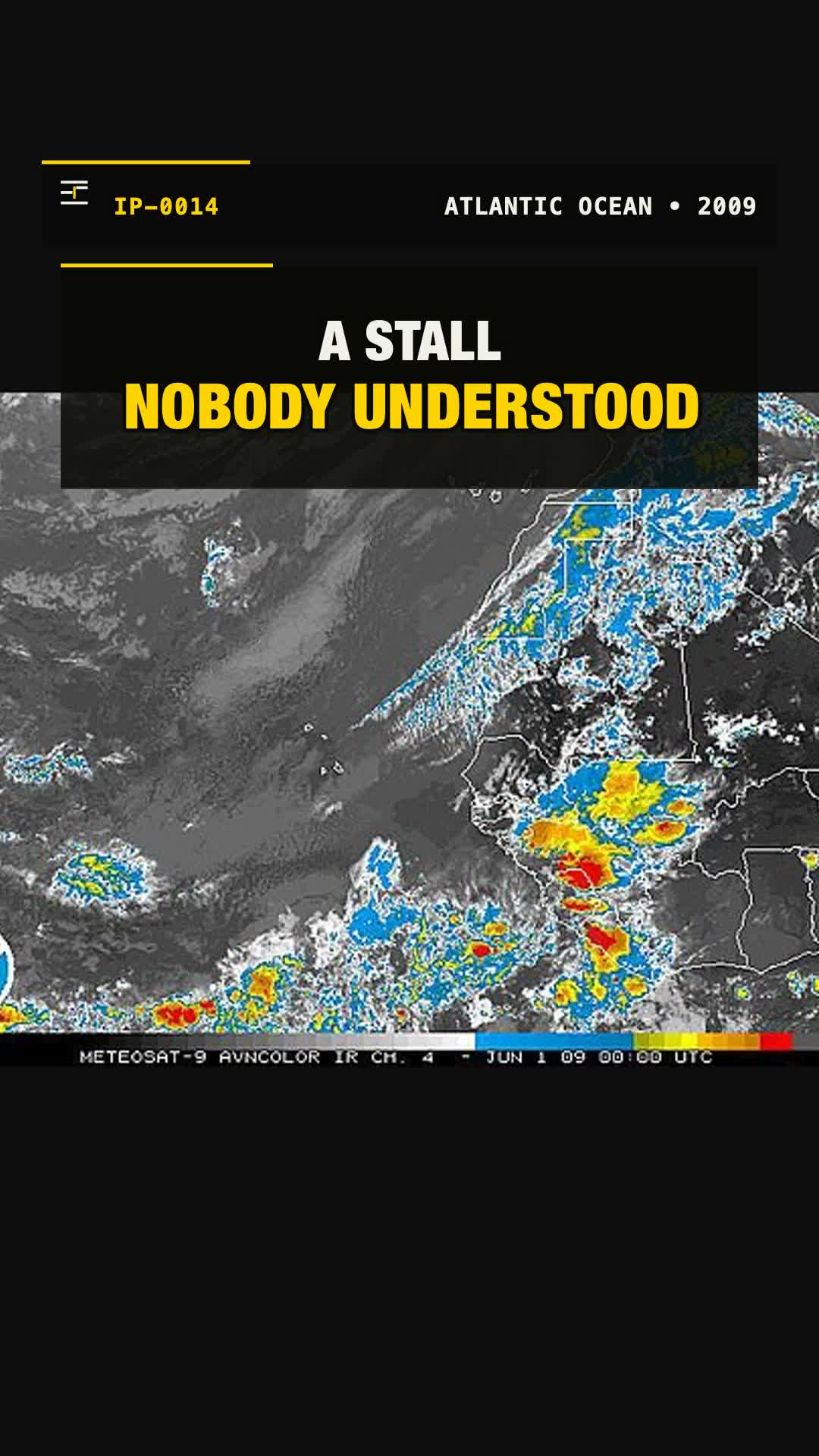
Air France Flight 447 was crossing the Atlantic from Rio de Janeiro to Paris when its airspeed indications temporarily became inconsistent in an area of intense weather.
All 216 passengers and 12 crew members died. Recovering the recorders and reconstructing the accident required a multi-year ocean search.
The mechanism.
Ice-crystal obstruction produced inconsistent airspeed indications, automation disconnected, and sustained nose-up inputs led to a stall that was not identified or recovered.
After the automation disconnected, control inputs destabilized the flight path. The aircraft entered a stall, but the crew did not identify the approach to stall or the stall itself.
Sources & references
Trace the evidence.
Media rights record: The aircraft photograph is CC0; NOAA weather imagery and the flight-path map are public domain. Original causal diagrams are Instinto Archive editorial work.
Discovery edition
The case in under one minute.
The Short introduces the event. This archive record preserves the mechanism, evidence, and engineering lesson beyond the video.
Short ready for releaseEditorial derivatives
Editions from this case.
A portable, source-backed edition of the complete case.
The failure sequence formatted for print and classroom display.
Mechanism, consequence, and lesson in one visual system.
Discussion prompts, activities, and a structured answer guide.
The question to remember
Did frozen sensors cause the entire accident?
They initiated the sequence, but the final report describes a larger chain involving automation behavior, control inputs, training, stall recognition, interface design, and crew coordination.