Structural Failures
Hyatt Regency Walkways
A fabrication change doubled the load on an already inadequate connection above a crowded hotel atrium.
The knowledge that remained
Knowledge that outlived the failure.
- 01
Fabrication changes that alter a load path require fresh engineering analysis.
- 02
Approval is not verification when the reviewer has not recalculated the changed connection.
- 03
Professional responsibility includes tracing how every design revision moves force through the structure.
The case became a landmark in structural engineering ethics and reinforced that engineers must retain responsibility for reviewing changes that affect safety.
Timeline
The sequence of failure.
- 01WarningDESIGN
Three walkways are suspended
The hotel atrium design hangs the second- and fourth-floor walkways in a stacked arrangement.
- 02InvestigationFABRICATION
The hanger detail changes
A proposed two-rod configuration replaces the original continuous-rod concept and is approved without a new analysis.
- 03FailureJUL 17, 1981
The connections fail
During a crowded dance event, the fourth-floor walkway falls onto the second-floor walkway below.
- 04InvestigationAFTERMATH
Responsibility is redefined
The disaster reshapes professional expectations for reviewing delegated designs and changes.
The event.
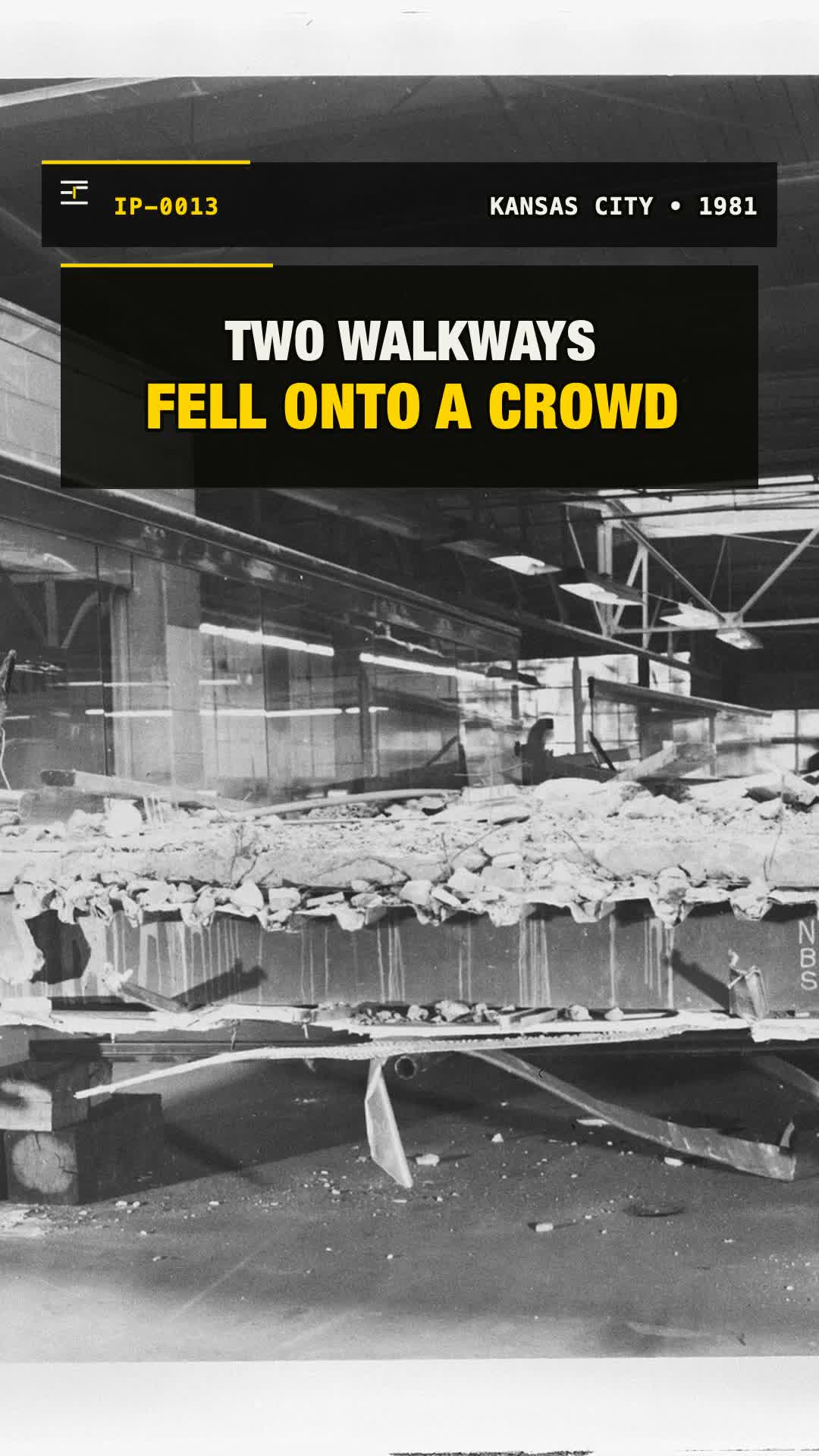
The Kansas City Hyatt Regency atrium contained suspended walkways above a popular gathering space. On July 17, 1981, the fourth-floor walkway collapsed onto the second-floor walkway during a dance.
The collapse killed 114 people and injured more than 200, making it one of the deadliest structural failures in United States history.
The mechanism.
A revised two-rod hanger detail doubled the load transferred through the fourth-floor box-beam connection, which was already substantially underdesigned.
The hanger-rod arrangement had been changed during fabrication. The engineer approved the revision without recalculating the resulting load at the box-beam connection.
Sources & references
Trace the evidence.
Media rights record: The case imagery reproduces United States National Archives investigation figures in the public domain.
Discovery edition
The case in under one minute.
The Short introduces the event. This archive record preserves the mechanism, evidence, and engineering lesson beyond the video.
Short ready for releaseEditorial derivatives
Editions from this case.
A portable, source-backed edition of the complete case.
The failure sequence formatted for print and classroom display.
Mechanism, consequence, and lesson in one visual system.
Discussion prompts, activities, and a structured answer guide.
The question to remember
Did the fabrication change alone cause the collapse?
It doubled the demand at the critical connection, but the original detail was already far below the required capacity. The collapse exposed failures in design, review, communication, and professional control.