Bridge Failures
Tacoma Narrows
The bridge that taught engineers that wind can feed motion until steel tears itself apart.
The knowledge that remained
Knowledge that outlived the failure.
- 01
Structural strength does not guarantee aerodynamic stability.
- 02
Flexible structures must be tested as systems interacting with moving air.
- 03
Small oscillations can become self-sustaining when each cycle adds energy.
The disaster changed how suspension bridges are designed and tested, making aerodynamic behavior a central part of long-span bridge engineering.
Timeline
The sequence of failure.
- 01Conditions1940
The bridge opens
A narrow, flexible suspension bridge begins carrying traffic across Puget Sound.
- 02FailureNOV 07
The deck begins twisting
Moderate wind drives the bridge into a violent torsional motion.
- 03FailureMINUTES LATER
Oscillations accelerate
Each movement feeds the next instead of fading.
- 04InvestigationAFTERMATH
Bridge design changes
Aerodynamic stability becomes central to long-span bridge engineering.
The event.
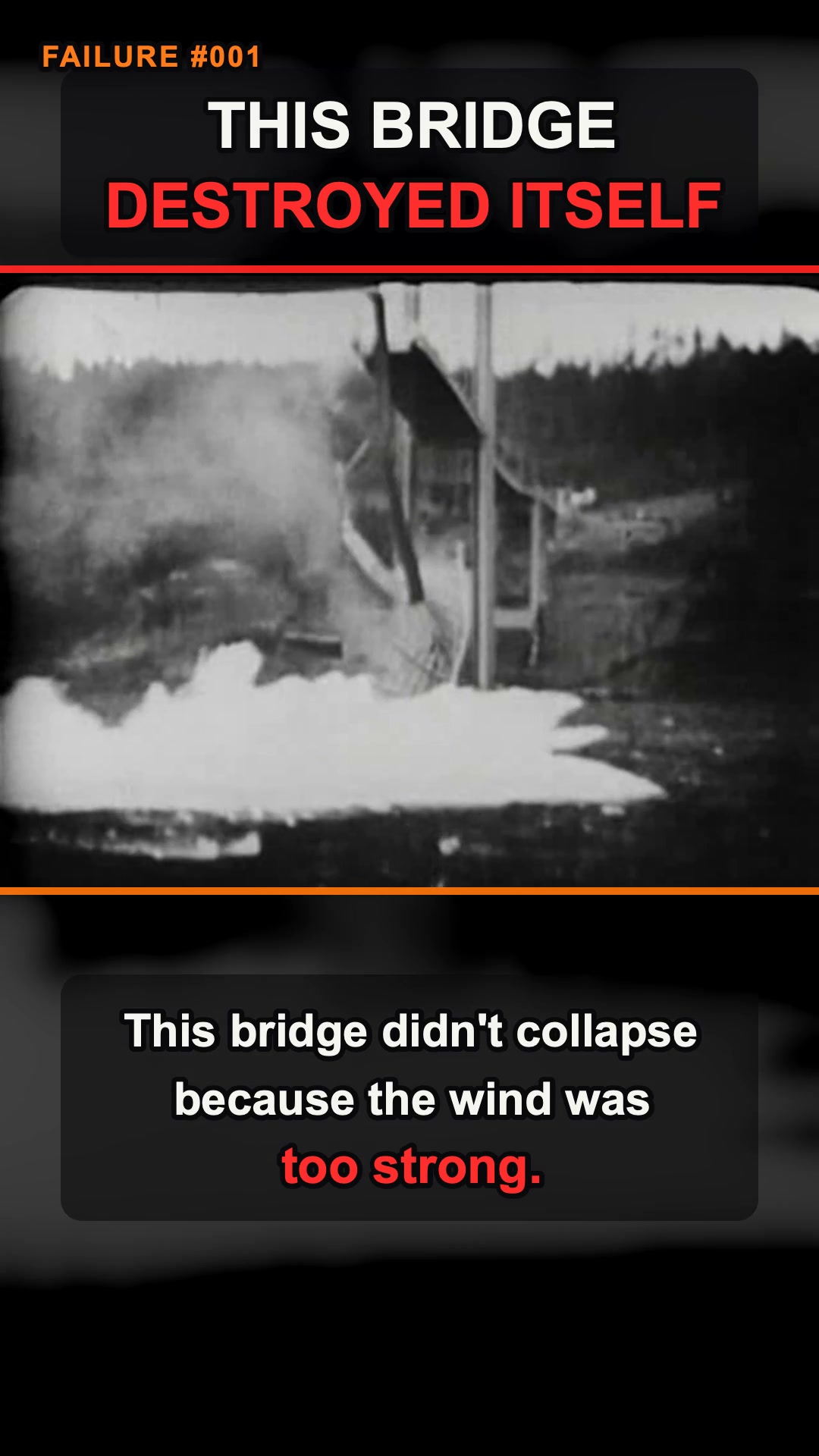
In 1940, the Tacoma Narrows Bridge began twisting violently in moderate winds. Its unusually narrow and flexible deck allowed each movement to feed the next.
The collapse became one of engineering history’s clearest demonstrations that structural strength alone is not enough. A bridge must also remain stable in moving air.
The mechanism.
Aeroelastic flutter amplified the bridge deck’s torsional motion.
The phenomenon is known as aeroelastic flutter: motion changes the airflow, the airflow adds energy to the motion, and the oscillation grows instead of fading.
Sources & references
Trace the evidence.
Media rights record: Archival footage by Barney Elliot, released into the public domain through the Prelinger Archives.
Discovery edition
The case in under one minute.
The Short introduces the event. This archive record preserves the mechanism, evidence, and engineering lesson beyond the video.
Editorial derivatives
Editions from this case.
A portable, source-backed edition of the complete case.
The failure sequence formatted for print and classroom display.
Mechanism, consequence, and lesson in one visual system.
Discussion prompts, activities, and a structured answer guide.
The question to remember
Could this happen today?
The failure mode still matters. Modern long-span bridges are designed and tested for aerodynamic stability precisely because Tacoma changed the discipline.